Middle School (Grades 6–9)
The Armenian national curriculum, enriched with school methodology and approach, is designed to provide passionate lifelong learners with a well-rounded education that fosters intellectual growth, critical thinking skills and personal development.
In our middle school, we provide a stimulating and supportive environment dedicated to the comprehensive personal, analytical, and academic development of students navigating their adolescent years.
Curriculum & Learning Model
National & International Integration: Education is delivered through the state national curriculum, harmoniously combined with best international practices.
English-Medium Integrated Subjects: Alongside the core national curriculum, subjects such as Science, Mathematics, and Social Studies are taught in English through a Transdisciplinary and Inquiry-Based Learningapproach.
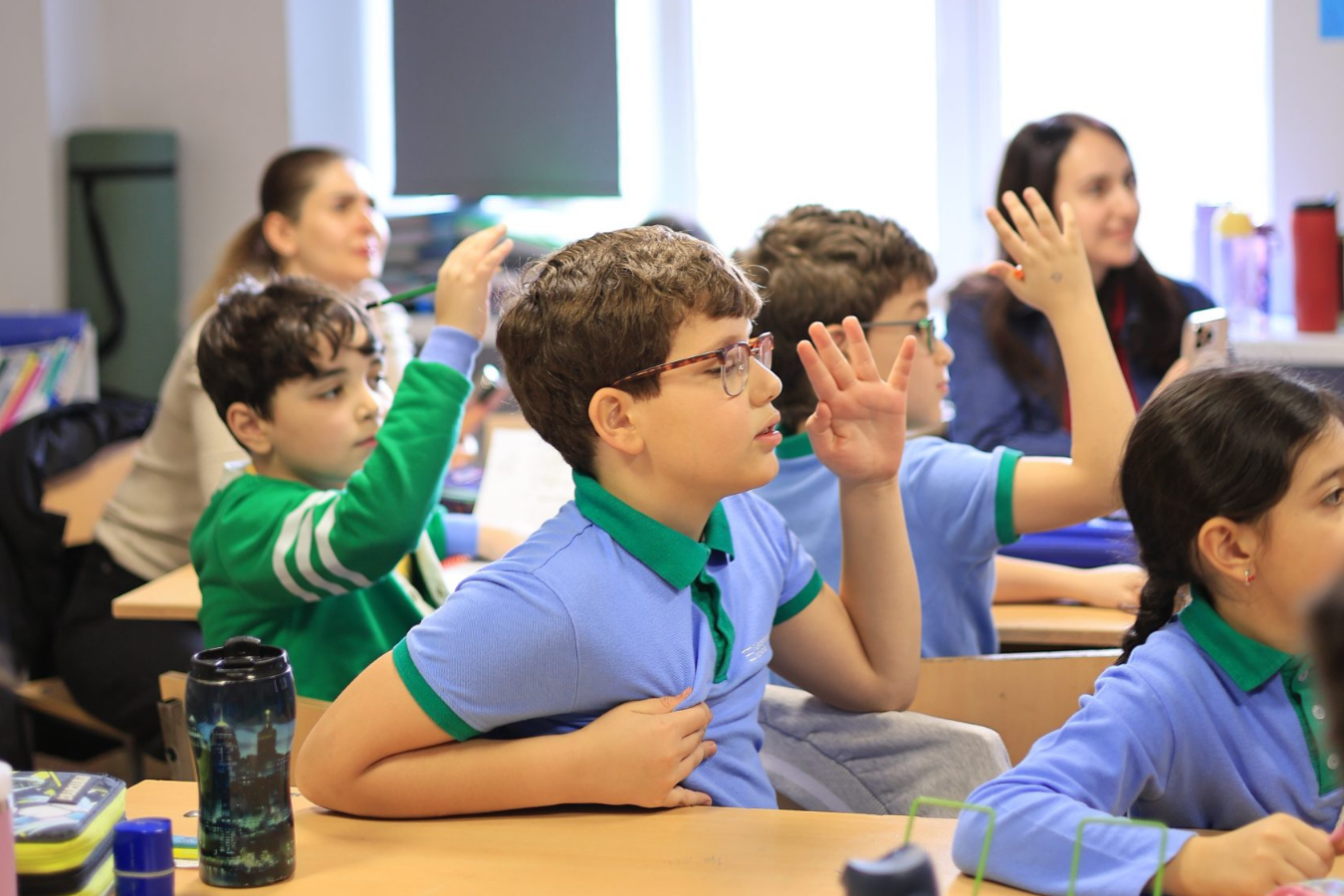
Differentiated Instruction: The educational process is organized using a Differentiate Instruction model, tailoring the approach to each learner’s unique needs, abilities, and interests.
State-of-the-Art Environment & Infrastructure
Our educational space is designed to foster high learning efficiency and comfort:
Modern Classrooms: Fully equipped with the necessary technical and digital tools.
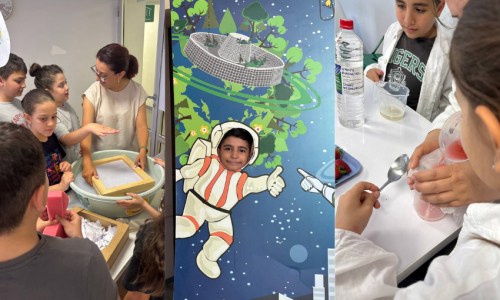
Science Laboratory: Providing hands-on opportunities for practical experiments and research activities.
Contemporary Library: A rich space with a wide collection of literature and educational resources.
Flexible Learning Spaces: Specially furnished areas for project work, group discussions, and creative activities.
Supportive Environment & Learner Well-being
The physical and psychological safety of every learner is our top priority:
Psychological Services: Active and targeted support for students navigating adolescence, helping them grow into Passionate Lifelong Learners (PLLs).
Child Protection Officer: Ensures a safe, respectful, and supportive environment throughout the school campus.
Specialist Support Team: Coordinated efforts focused on identifying individual needs and fostering personal development.
steam projects
Our school provides project-based education with implementation of integrated subjects.
STEAM education is an interdisciplinary approach to learning that integrates Science, Technology, Engineering, Art, and Mathematics. STEAM aims to develop critical thinking, creativity, and problem-solving skills by emphasizing the connections between these subjects.

Science
Encourages understanding, investigation, and experimentation of natural phenomena.

Technology:
Explores the application of digital tools and innovations, preparing learners to navigate a technology-driven world.

Engineering:
Focuses on design and problem-solving, where learners apply scientific and mathematical knowledge to create solutions.

Art:
Encourages creativity and innovation by using the visual, performing, and language arts to complement scientific inquiry and technological development.

Mathematics:
Provides a foundation for quantitative reasoning and helps learners understand real-world patterns, structures, and relationships.
By integrating these subjects, STEAM education seeks to create a more holistic learning experience by encouraging learners to think outside the box, apply their knowledge to real-world contexts, and become open-minded, innovative thinkers. It also emphasizes collaborative learning, project-based activities, and hands-on experience.

project aims
- transdisciplinary education
- contribute to the development of passionate lifelong learners’ research abilities
- develop skills in planning, time management, and finding effective solutions to problems
- develop skills of applying theoretical knowledge in practice, systematic presentation of the studied material
- promote the development of knowledge-based judgments, logical and analytical thinking.
- to engage professionally in diverse teams to advance organizational and social goals.
- to form personalities that create tangible value, innovative personalities who can identify problems, collect information, explore, analyze, experiment, generalize and make discoveries.
The Importance of STEAM Education
The cornerstone of STEAM education is a holistic approach to learning that prepares learners for the future by integrating creative and critical thinking with traditional technical fields. Here are some reasons why STEAM education is important in the classroom:
1. Promotes Innovation and Creativity
Incorporating the arts into STEM encourages students to think creatively, creating innovative solutions to complex problems. Creativity paves the way for students to overcome challenges in science, engineering, and technology, leading to more breakthrough discoveries.
2. Prepares students for future careers
Many of the fastest-growing career fields, such as data science, AI, engineering, and robotics, require a strong foundation in STEAM subjects. The integration of these subjects helps students develop the skills needed for future jobs that require both technical and creative thinking.
3. Enhances problem-solving and critical thinking
STEAM education focuses on real-world, project-based learning. Students work on interdisciplinary problems, developing critical thinking and analytical skills by applying their knowledge across disciplines.
4. Encourages collaboration and teamwork
STEAM activities often involve teamwork, reflecting professional environments where collaboration across disciplines is essential. This helps learners develop communication and collaboration skills that are essential in any career.
5. Promotes adaptability and flexibility
In an ever-evolving global economy, adaptability is key. STEAM education promotes flexible thinking by blending different disciplines, and “training” learners to adapt their skills to different challenges.
6. Develop 21st-century skills
STEAM education’s focus on technology and engineering equips learners with digital literacy and technological skills, while the arts Inclusion fosters creativity, empathy, and communication, which are essential for the 21st-century individual.
7. Increases engagement and motivation
The project-based, hands-on learning experiences that are characteristic of STEAM education often lead to higher levels of student engagement.
8. Solves real-world problems
STEAM education encourages learners to solve real-world problems, such as climate change, health crises, or technological advances, using a multidisciplinary approach.
9. Encourages lifelong learning
STEAM education emphasizes the curiosity and ongoing nature of inquiry-based learning. By fostering a passion for inquiry and discovery, project-based education fosters lifelong learners who are open to new ideas and technologies.
Frequently Asked Questions (FAQ)
What educational program does the European School implement?
The European School implements an exemplary general education program combined with international components. The educational process also includes subjects taught through international platforms (taught in English for grades 6-9):
- Language and literature (English)
- Language acquistion
- Sciences (Physics, Chemistry, Biology)
- Mathematics
- Design
- Arts (Visual Arts/Performing Arts)
- PHE
Does the school have an international status?
Yes. The school is an IB PYP (International Baccalaureate Primary Years Programme) candidate school. Additionally, the school holds an American accreditation from the ARRAY Global international organization.
What grades is the education intended for?
The school provides education for students from grades 1 to 9.
How many students are there in one class?
The maximum number of students in a class is set at 20. This allows us to ensure an individual approach and highly effective learning for each student.
What are the school's working hours?
The school operates daily from 08:30 to 18:00.
How is the school day organized?
The educational process is tailored according to age groups:
Grades 1-5: 09:00-18:00 (educational classes), 13:45-14:30 (rest hour accompanied by the homeroom teacher. The program includes: recreational-relaxing games, physical exercises, and national dances).
Grades 6-8: 09:00-14:30 (educational classes), 14:30-15:15 (rest hour), 15:15-17:40 (targeted subject preparation accompanied by subject teachers).
Grade 9 (Streamed classes): 09:00-16:40.
What does the extended day program include?
The extended day program ensures an effective and enriched routine for the child, including:
homework preparation,
rest and relaxation hours,
recreational and developmental games,
physical exercises and national dances,
constant accompaniment by homeroom and subject teachers.
Is food provided at the school?
Yes. The school provides 3 fresh and healthy meals prepared on-site daily.
How is the admission process carried out?
Admission is carried out in 3 simple stages:
Completion of an application form by the parent.
Testing in 3-4 subjects (Native language, Mathematics, English, Russian — depending on the age group).
Meeting with the school psychologist.
Is there a discount system available?
Yes, the school has a flexible discount system:
For 2 newly enrolled children: The younger child receives a 15% discount.
For 3 or more newly enrolled children: The second (younger) child receives a 15% discount; the third and subsequent children receive a 20% discount.
For children transferring from the European Kindergarten: A 15% discount is provided.
For siblings of students enrolled before the 2025-2026 academic year: A 10% discount is provided to both the current student and the newly enrolled sibling.
Does the school provide transportation?
Yes, the school offers safe transportation services with options for one-way or two-way transfers.
Why choose the European School?
The European School combines all the essential conditions necessary for the harmonious development of a child:
education meeting international standards,
an individual approach and small classes,
a safe and caring environment,
multilingual education,
an effective extended-day developmental program,
modern and value-based educational approaches.
Thank you for your trust. We look forward to welcoming you to the European School.
Where is the school located and how can we get in touch?
Address: D. Anhaght 10/3
Phone Number: 091 04 66 85